
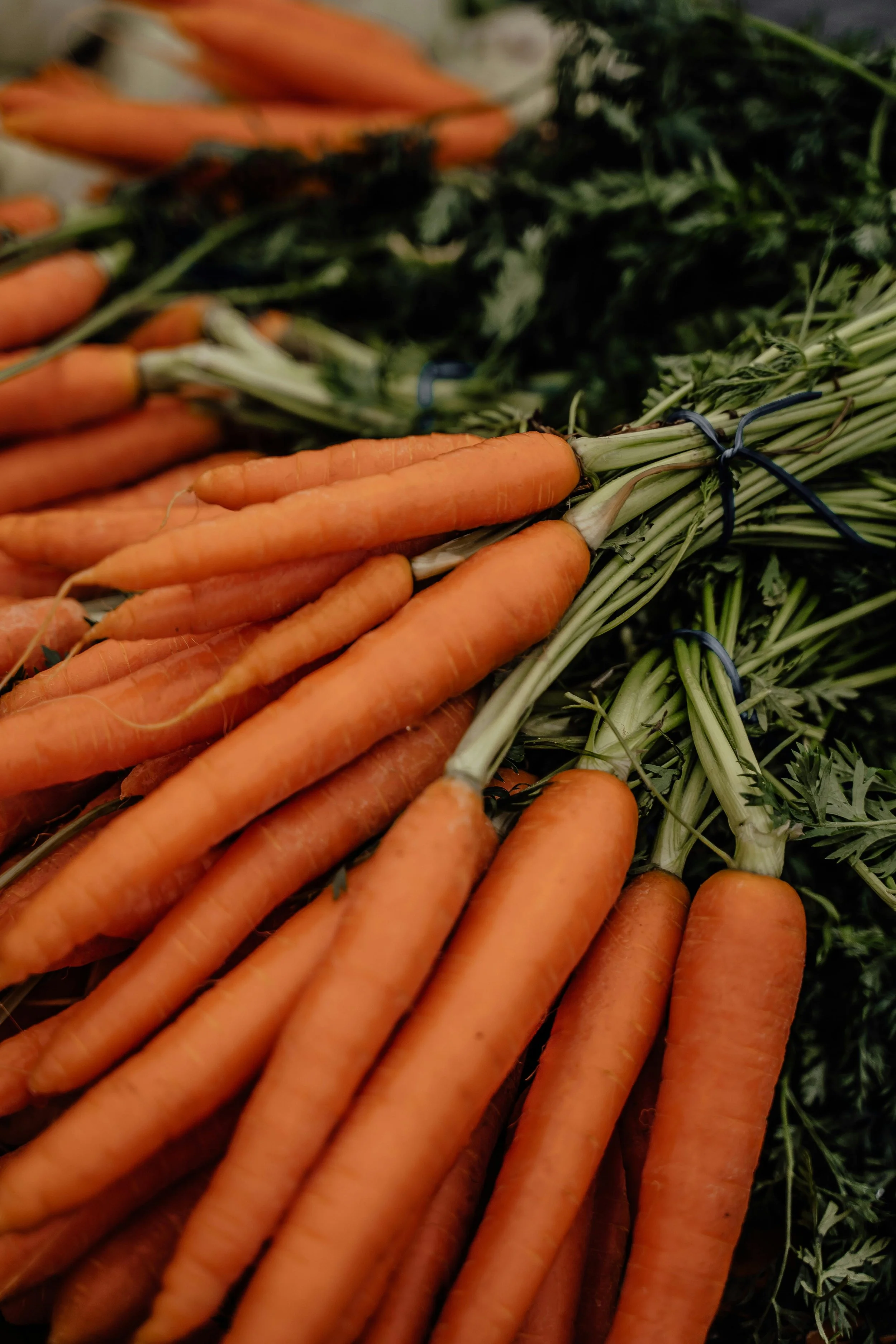
FACT FILE: CARROTS
Carrots are superfoods we should be eating everyday- they are packed full of nutrients and are super good for human bodies. Read on for information about their health benefits, key phytonutrients, and suggestions for cooking, usage and storage.
-
Carrots are a root vegetable with most having orange flesh and green leaves.
Carrots come in many colours: white, yellow, orange, red and purple.
Carrots are related to parsnip, celery, parsley, fennel, cumin, caraway, and dill.
-
To get the most out of your carrots nutritionally: steam 2-3cm wide x 4cm long pieces for 7 minutes. You don’t need to, but you can peel them first if you prefer.
Over-cooking and boiling reduces the nutritional power, but makes them taste sweeter (which may help kids eat more of them).
Sous-vide cooking (at temperatures 10-15°C lower than boiling/steaming) is really good at maintaining nutritional composition of carrots.
Blending cooked carrots (with some oil) increases the beta-carotene your body will absorb, enormously. Enjoy blended carrots in a burger or dip, or as a sauce for meals.
Frozen carrots are also excellent, nutritionally.
If your refrigerated carrots have gone bendy: add them to a soup or stew – the fibre, and sweetness will still be there. If they’ve gone mouldy: don’t eat them.
Enjoy purple carrots raw for best effect.
-
Carrots vary in sweetness and in pine/parsley notes, which can also taste bitter/woody.
Bitter compounds are found in the peel, so if they taste too strong for you: peel and cook for slightly longer to reduce this.
The 'white blush' which sometimes appears on the surface of refrigerated carrots is a harmless discolouration resulting from moisture loss or abrasion during storage. It has nothing to do with chlorine and does not affect the taste or nutritional value of the carrots.
Use carrot leaves in a salad, or blend up with some basil, oil, parmesan and pine nuts to make pesto.
Great carrot flavour pairings:
Star anise, cardamom, cinnamon, cumin, caraway
Apples and Oranges
Celery, Cabbage, Onions and Swedes
Walnuts, hazelnuts, peanuts and coconut
Olives and beef.
To make your carrot cake even more awesome: Add cinnamon, hazelnut oil and some coconut; top with an orange zest-infused creamy (nut) cheese topping and sprinkle on some walnuts! Yum!
Make a scrumptious simple coleslaw with grated carrot, finely sliced purple cabbage, Granny Smith apple and celery, sprinkle on a few caraway seeds and some walnuts, and dress with a blue cheese dressing.
-
If you buy your carrots just as roots (no tops), store them in the vegetable drawer in a plastic bag for up to 2 weeks (longer should also still be fine to eat).
If you buy them with tops: remove and use the tops (makes a great salad or pesto), and store roots as above. Leaving the tops on dries the carrots out.
-
One serve of carrots is 75g, which is about 1 medium or ½ a large carrot. This much carrot provides:
A good** source of Vitamin A (retinol), from beta-carotene.
A source* of Fibre
A source* of Potassium
A source* of Vitamin B6 (pyridoxine)
A source* of Vitamin C (ascorbic acid)
A source* of Vitamin K
*A source means one serve provides at least 10% of the Recommended Daily Intake, or at least 2g in the case of fibre.
**A good source means one serve provides at least 25% of the Recommended Daily Intake, or at least 4g in the case of fibre.
As a source of Fibre, Potassium, Vitamins B6, C and K, and a good source of Vitamin A, one serve (75g) of carrots contributes to:
A healthy brain and nervous system.
Energy and normal metabolism.
Healthy bones and joints.
A Healthy heart and circulation.
Healthy immune system.
Healthy skin.
Healthy digestion.
Good hydration.
-
Carrots are one of the few vegetables that contain a good source level - well over 25% of the RDI per serve - of a vitamin, in this case Vitamin A. Actually, they contain very high levels of orange coloured beta-carotene, which is converted by our bodies into Vitamin A.
The darker/brighter orange the carrot, the more beta-carotene it contains.
Beta-carotene is fat-soluble, so your body absorbs more if you eat carrots with oil/butter.
Beta-carotene also has potent antioxidant capacity, a wide array of proven health benefits including reducing the risk of heart disease, certain cancers, and enhances the immune system, as well as conferring protection from age-related macular degeneration.
Ingesting beta-carotene from food is far more effective than taking a supplement.
Red carrots contain lycopene – which is related to beta-carotene and also found in tomatoes and watermelon.
Purple carrots contain water-soluble anthocyanins, as do blueberries. Some carrots are purple outside and orange inside.
Carrots also contain polyacetylenes like falcarinol. These have a bitter taste, and there is more in raw carrots. Recent research shows these may be the cause of the anti-cancer effects from eating carrots, potentially by modifying gut bacteria.
Carrots also contain water-soluble phenolics – chlorogenic acid – at levels about half those found in blueberries.
In conclusion: We don’t know exactly why, but carrots truly are SuperFoods! Eat at least 1 big one, every day.
However:
Carrots are a medium-risk plant in terms of potentially causing allergic reactions in people with latex allergies.
Excessive consumption of carrots (>10 per day for 2 weeks) can cause the skin of your palms, the soles of your feet and the skin behind your ears to turn yellowish; this is called carotenodermia, and is reversible (eat less carrots!).